

The University of Maryland is committed to providing transformative experiences that foster the development of well-rounded scholars capable of applying their learning to make meaningful impacts in their respective fields and communities. One way the university facilitates this growth is through experiential learning.
Experiential learning is a carefully designed pedagogical approach that centers on authentic experiences to strengthen students' knowledge, skills, and abilities, paired with structured reflection to deepen understanding and insight. Seven attributes characterize experiential learning; read below for details:
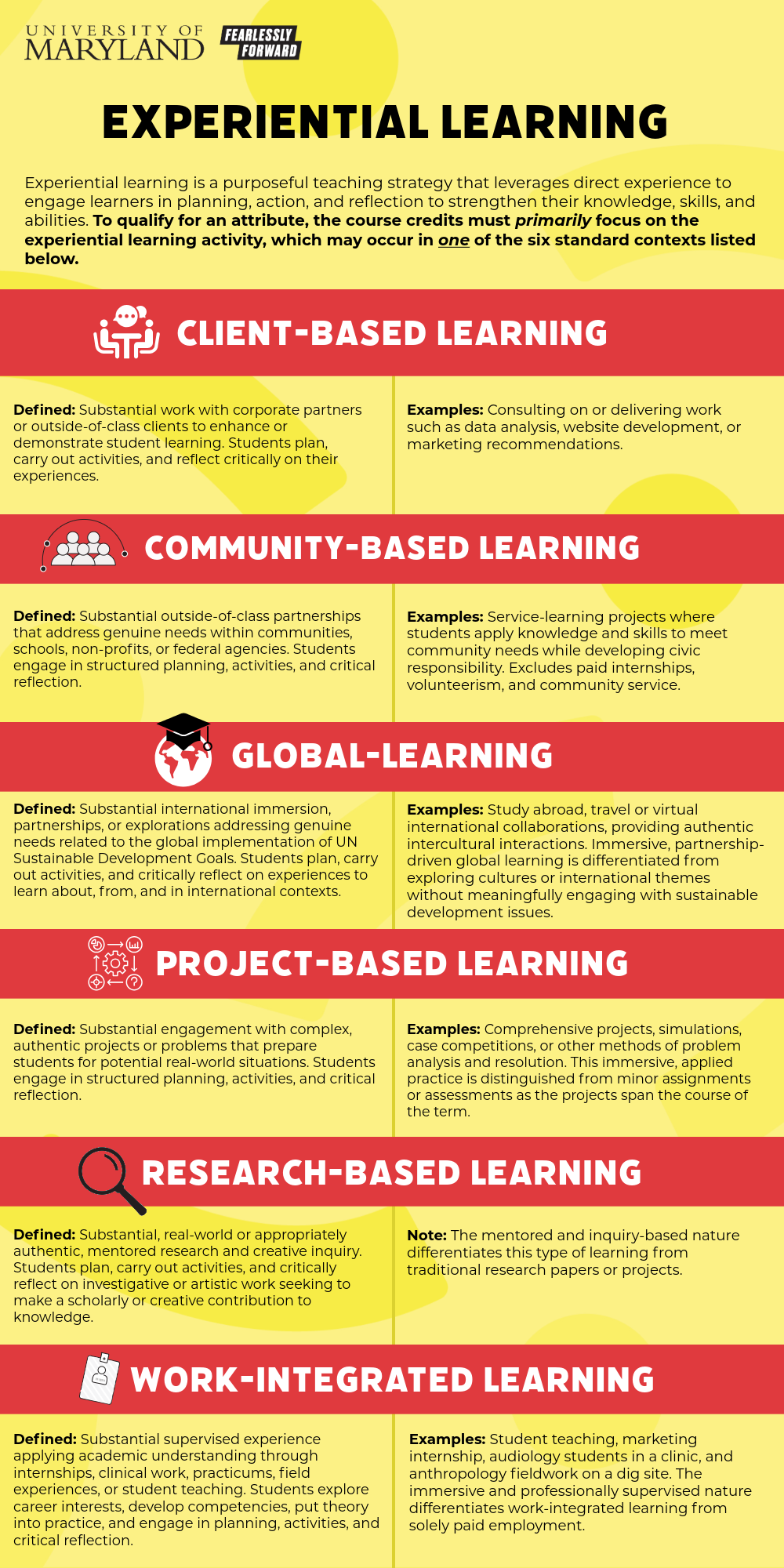
Here is a print-ready version of the definitions above.
The definitions above represent the work of the Academic Affairs Experiential Learning Working Group (2024), which was comprised of the following members:
- Tania D. Mitchell, Professor & Associate Provost of Community Engagement
- Mary Warneka, Director of Teaching Innovation, Teaching & Learning Transformation Center
- Michelle Appel, Assistant Vice President, Office of Institutional Research, Planning & Assessment
- Douglas Roberts, Associate Professor & Associate Dean, Undergraduate Studies
- Alan Socha, Associate Director, Office of Institutional Research, Planning & Assessment
- Michael Colson, Senior Coordinator for Academic Programs
- Michelle Tan, Associate Registrar, Office of the Registrar
- Courtney Holder, Assistant Director, Leadership & Community Service Learning
Our group would also like to acknowledge the many non-credit, co-curricular experiences on campus that support students to develop and apply knowledge, skills, and abilities. Students experiencing campus-based leadership roles, on-campus employment, student-driven campus events, experiential student organizations, and other co-curricular activities learn meaningful and important skills from these activities.