
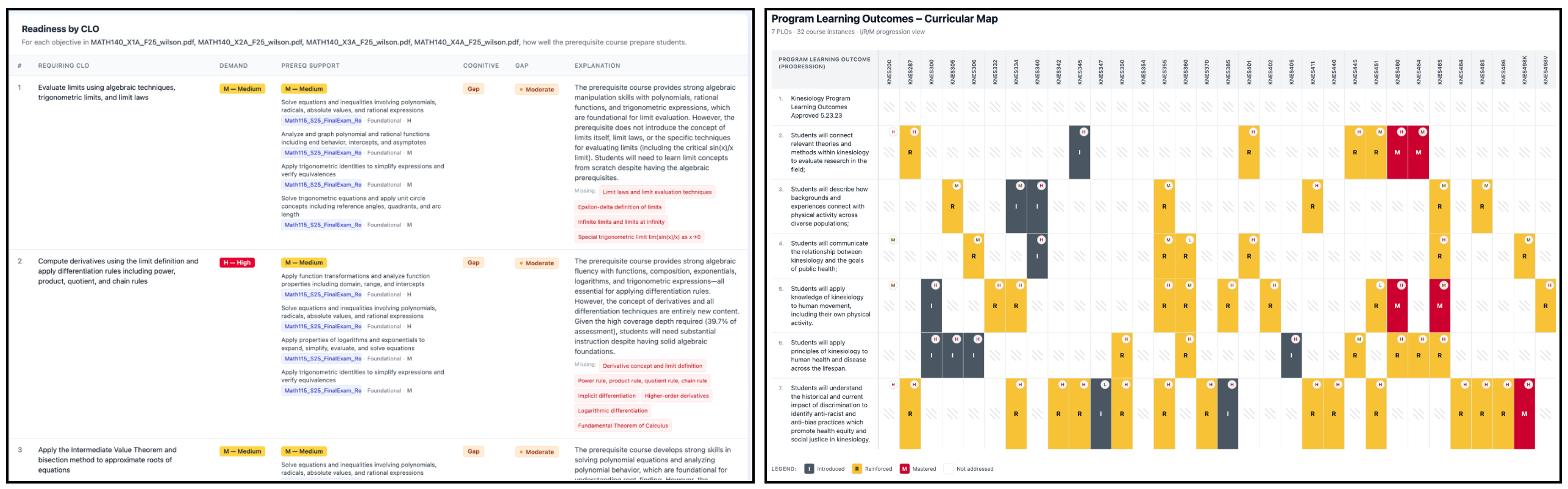
The AI Course Alignment tool for Coordinators provides all the functionality of the Instructor version plus the ability to easily extract course learning outcomes, map course learning outcomes across a selection of courses, look at content overlaps and gaps between courses and their pre-requisites, determine program learning outcomes and map courses to those outcomes and/or map courses to existing program outcomes.
What can you do with the tool?
- Extract Learning outcomes - extract course learning outcomes from the minimum of a syllabus to a collection of numerous course artifacts and map level of emphasis of each of the outcomes (with underlying information identified when making the determination).
- Map learning outcomes between courses - compare learning outcomes from 2 or more courses, or units of instruction, in a grid mapped to the common learning outcomes.
- Content alignment between courses and their pre-requisites - gauge alignment between 1 or more pre-requisite courses and the requiring course with specific information on pre-requisite support and content gaps between offerings.
- Extract program learning outcomes and map course learning outcomes to them - determines program learning outcomes and creates a curricular map that shows the connection and depth (introduced, reinforced, mastered) with which each course addresses a particular program learning outcome. Also provides the underlying information the model used to make the determination.
- Map course learning outcomes to existing program learning outcomes - maps selected courses to a user-provided set of program learning outcomes and shows the connection and depth (introduced, reinforced, mastered) with which each course addresses a particular program learning outcome. Also provides the underlying information the model used to make the determination.
Current/Potential Outcomes
- IExtraction of course learning outcomes for comparison between different instances of the same course.
- Improved selection of pre-requisite courses based on what is taught/covered in current instances of the pre-requisite course/s and the course requiring them..
- Development of program learning outcomes based on current courses required in a program and what they are currently teaching. Can help look for redundancy and potential simplification of program requirements.
- Improved mapping of courses to internally developed program learning outcomes using materials from existing courses being currently taught.
- Determination of potential course articulation mismatches that can contribute to lower outcomes for transfer students.
- Simplified determination of changes in program learning outcomes for specializations within programs and level of difference.
- Gauge program learning outcome impacts of potential changes in required courses.
Users
- Directors of Undergraduate programs.
- Special curricular project leaders.
Accessing Tool
- To access the tool you need to attend a short training session to learn the basics of the tool and then you are off and running! Sign up for your training session.